No Fur on the Official Runway: What New York's New Rule Means for Indian Fashion
New York Fashion Week opens on September 10 with a rule that has never applied to the official calendar before. Every collection shown on the Council of Fashion Designers of America's schedule must be free of animal fur. The CFDA announced the policy in December 2025 and gave designers nine months to adjust their materials. This week the grace period ends, and roughly 70 shows and presentations for spring/summer 2027 will walk under it.
For Indian fashion, the timing is hard to ignore. Sabyasachi Mukherjee makes his official New York Fashion Week debut at 4pm on September 15, the closing day, just before Thom Browne shuts the week. Prabal Gurung shows on September 12 and Bibhu Mohapatra on September 14. Three names with South Asian roots on the same calendar, in the first season where the calendar itself carries a materials rule.
What the rule actually says
The CFDA's wording is specific. Farmed or trapped fur from animals killed for their pelts, including mink, fox, rabbit, karakul lamb, chinchilla, coyote and raccoon dog, is not permitted in any collection on the official schedule. The only exemption is fur obtained by Indigenous communities through traditional subsistence hunting. The policy was developed with Humane World for Animals and Collective Fashion Justice, and the CFDA has said it will support designers with a material library and educational resources during the transition.
New York is not the first. London Fashion Week stopped promoting fur in 2023, and Copenhagen, Berlin, Stockholm, Amsterdam, Helsinki and Melbourne have similar positions. Condé Nast, the publisher of Vogue, dropped animal fur from editorial and advertising in 2025, following ELLE and InStyle. Milan and Paris remain the holdouts, which is exactly where the campaign groups have said they will turn next.
CFDA chief executive Steven Kolb has been open about the fact that there was already very little fur on New York runways. The rule is less about removing pieces from racks and more about a public position. Consumers, in his framing, are moving away from products linked to animal cruelty, and American fashion wants to be seen leading rather than following.
Why India was already here
Fur has never had a natural home in Indian fashion. Climate is the obvious reason, but the deeper one is that the country's design language was built on textiles and hand skills rather than pelts. Zardozi, chikankari, bandhani, Banarasi brocade, Kanjeevaram silk and the block prints of Rajasthan are the materials Indian designers take abroad. When Sabyasachi walks in New York next week, the embroidery will be doing the work that fur once did on Western runways: signalling time, cost and craft.
India has also had its own policy history here. In January 2017 the Directorate General of Foreign Trade prohibited the import of mink, fox and chinchilla fur skins along with reptile skins, a decision that animal welfare groups credited to sustained lobbying. The rule has since been revisited, but the principle that fur is an imported luxury with no roots in Indian dress has held.
That is why the New York rule reads less as a restriction on Indian designers and more as the global calendar catching up to a position India's craft economy took by default. Earlier this summer, India Couture Week put karigars on the runway to take the final bow. The materials story at the top of Indian fashion is already about hands, not hides.
What changes for models
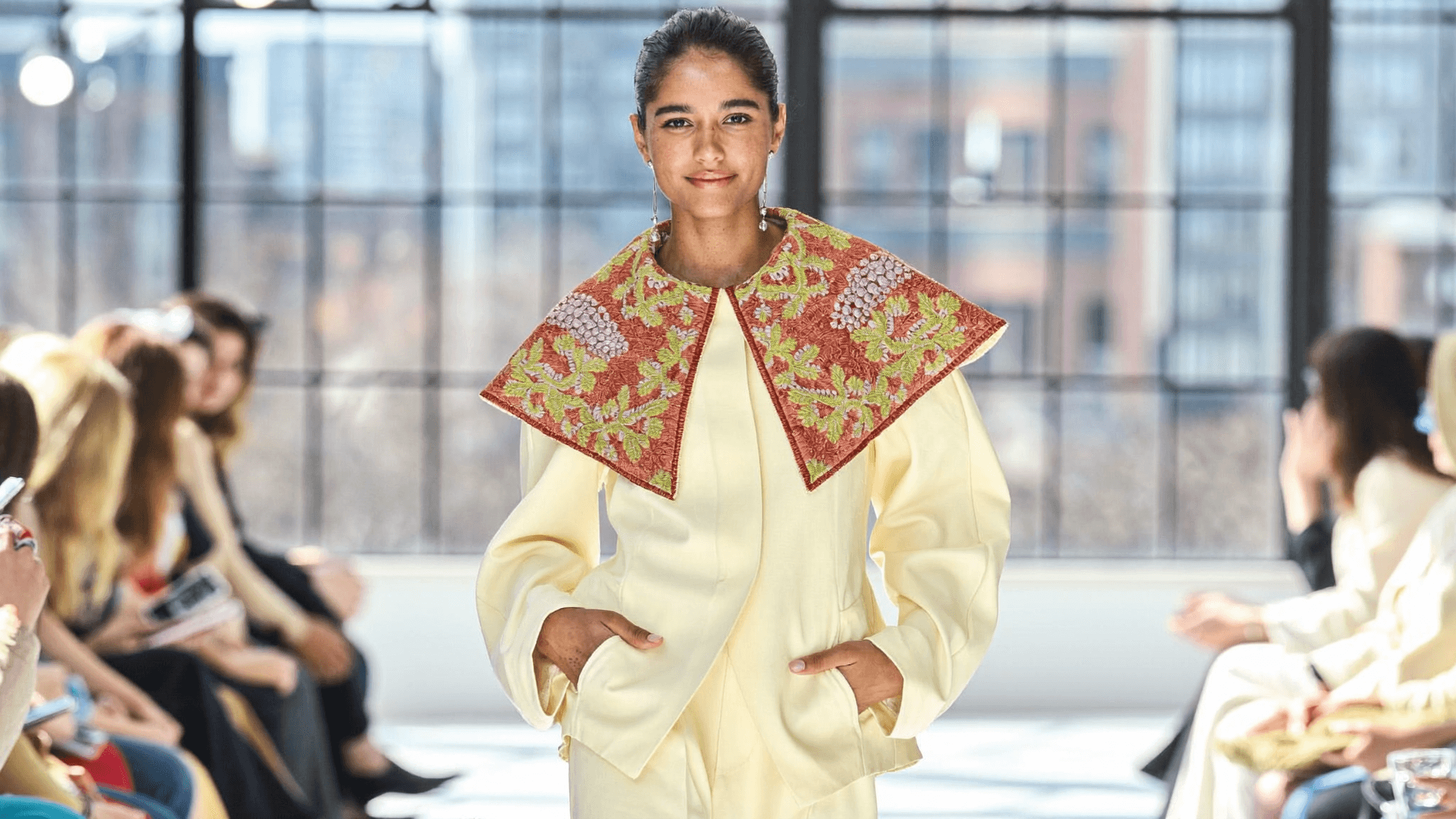
For the model walking the show, a fur-free calendar changes the job in quiet ways. Styling briefs shift toward layered textiles, knits, technical outerwear and next-generation materials, which move differently on the body and photograph differently under runway light. A designer replacing a fur collar with a heavily worked embroidered one is also asking the model to carry weight in a different place.
There is a commercial side too. Brands that adopt fur-free positions tend to build campaigns around that story, and casting for those campaigns favours faces that read as modern, conscious and international. Indian models have been gaining ground on exactly those briefs for two seasons now, from Chanel to Versace, and a materials rule that rewards craft over pelts plays to the strengths of the country they come from.
The runway is becoming a place where what a garment is made of matters as much as how it is cut.
Working models increasingly get asked at castings whether they will wear fur, leather or exotic skins. Knowing where the major calendars stand is now part of professional literacy, in the same way that knowing a show's call time is.
The road to Delhi
Lakmé Fashion Week x FDCI returns to New Delhi from October 15 to 18 for its Winter/Festive edition, a month after New York closes. India's fashion weeks have never needed a formal fur ban, but the direction of travel across London, Copenhagen and now New York means the question of a written materials policy will eventually reach Indian organisers too. Given how the industry here is already built, that conversation should be shorter than it was anywhere else.
The bigger story this September is not what has been removed from the New York runway. It is that the qualities being rewarded in its place, hand skill, textile depth and material honesty, are the ones India has been exporting all along. For the international models working out of Mumbai, and for the Indian faces walking New York this week, that is a market moving in their favour.